Local SEO for plumbers: rank your plumbing business in the map pack
A practical guide to plumber SEO across profile setup, service pages, reviews, audits, and map pack measurement.
Complete, accurate information helps Google match a business to the right searches. SEO for plumbing companies should start with that information: the profile, the service pages and the reviews.
The scope of local SEO for plumbers
Plumber marketing needs to connect several assets. Your listing presents the business in local search. Your website explains the work you perform. Reviews provide customer feedback about that work.
Google identifies relevance, distance, and prominence as its local ranking factors (accessed November 2026) (Multi-location local SEO platforms for healthcare clinics). You can provide complete, accurate information to help Google match your business to the right searches. You cannot control the searcher’s location or competitor activity.
That limit matters when you assess SEO for a plumbing business or hire a local plumber SEO agency. A report can identify missing information, inconsistent data, website content issues, and review activity. It cannot turn those checks into a reliable forecast of a future position.
Configuring a service-area profile
Most contractors have an office nobody visits and sites the public cannot enter. A service-area business without a customer-accessible office must hide its street address and specify the areas it serves (accessed November 2026).
A visible address should represent a place where customers can visit during the stated hours (accessed November 2026). A warehouse, private home, or dispatch point should not be presented as a showroom merely to place another pin on the map. This is a normal operating model for plumbing businesses, not a disadvantage by itself.
Your primary category should describe the trade that produces most of the business’s revenue. Secondary categories should cover only work delivered by your own crews. Categories are not a substitute for a long service list.
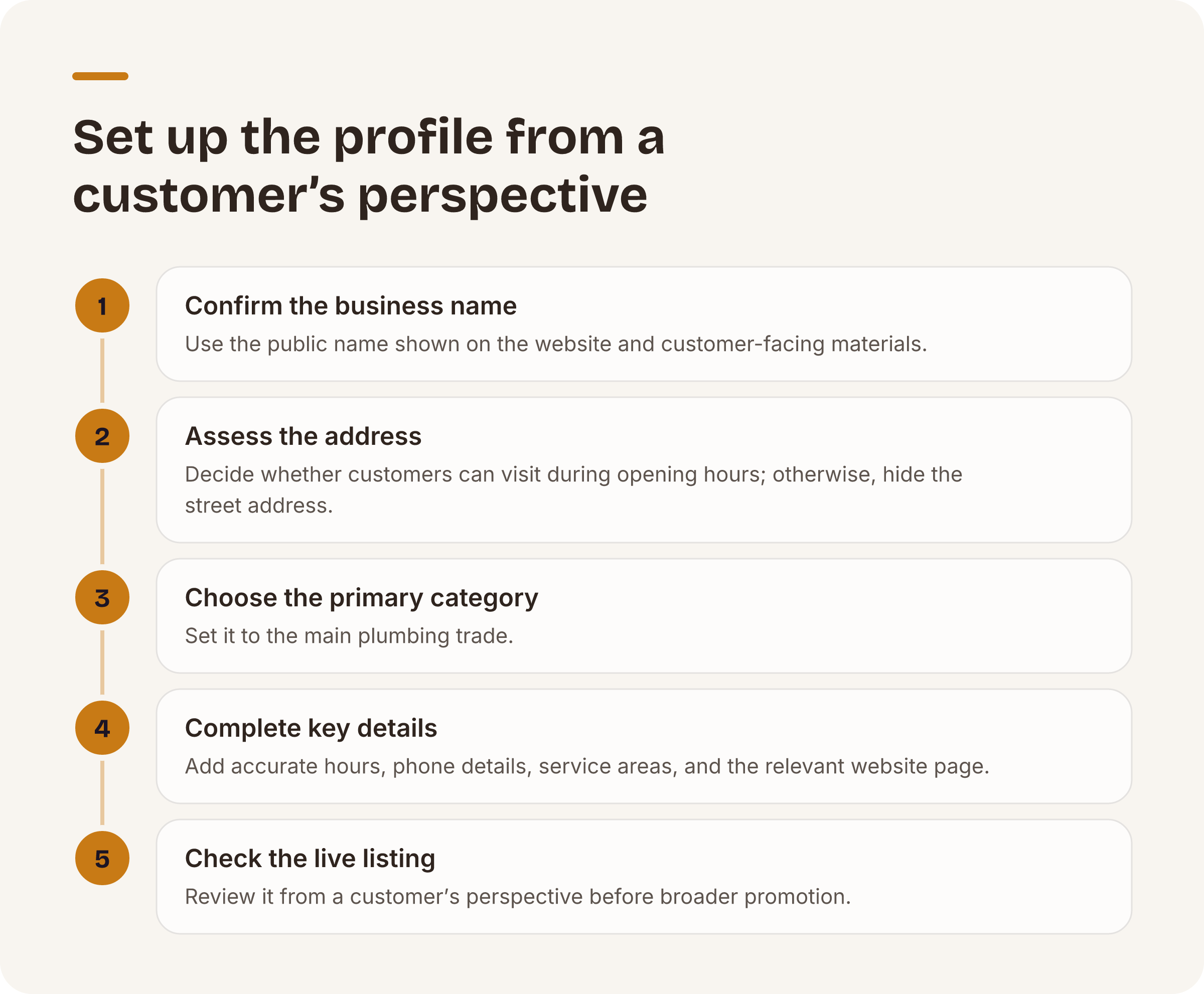
Use a simple setup sequence:
- Confirm the public business name used on your website and customer-facing materials.
- Decide whether customers can visit the stated address during opening hours.
- Set the primary category to the main plumbing trade.
- Add accurate hours and phone details. Define the service areas and link to the relevant website page.
- Check the live listing from a customer’s perspective before beginning broader promotion.
For a multi-location portfolio, keep the business name and primary category consistent. Use a consistent website structure and phone-number format unless a location has a genuine operational difference (accessed November 2026). Consistency does not mean replacing valid local details with a single corporate phone number.
SEO for plumbing: what each service page needs
The homepage should establish the company and its main service area. It should also provide a clear route to request service. Individual pages can then answer narrower needs such as drain cleaning, water heater repair, leak detection, or sewer work.
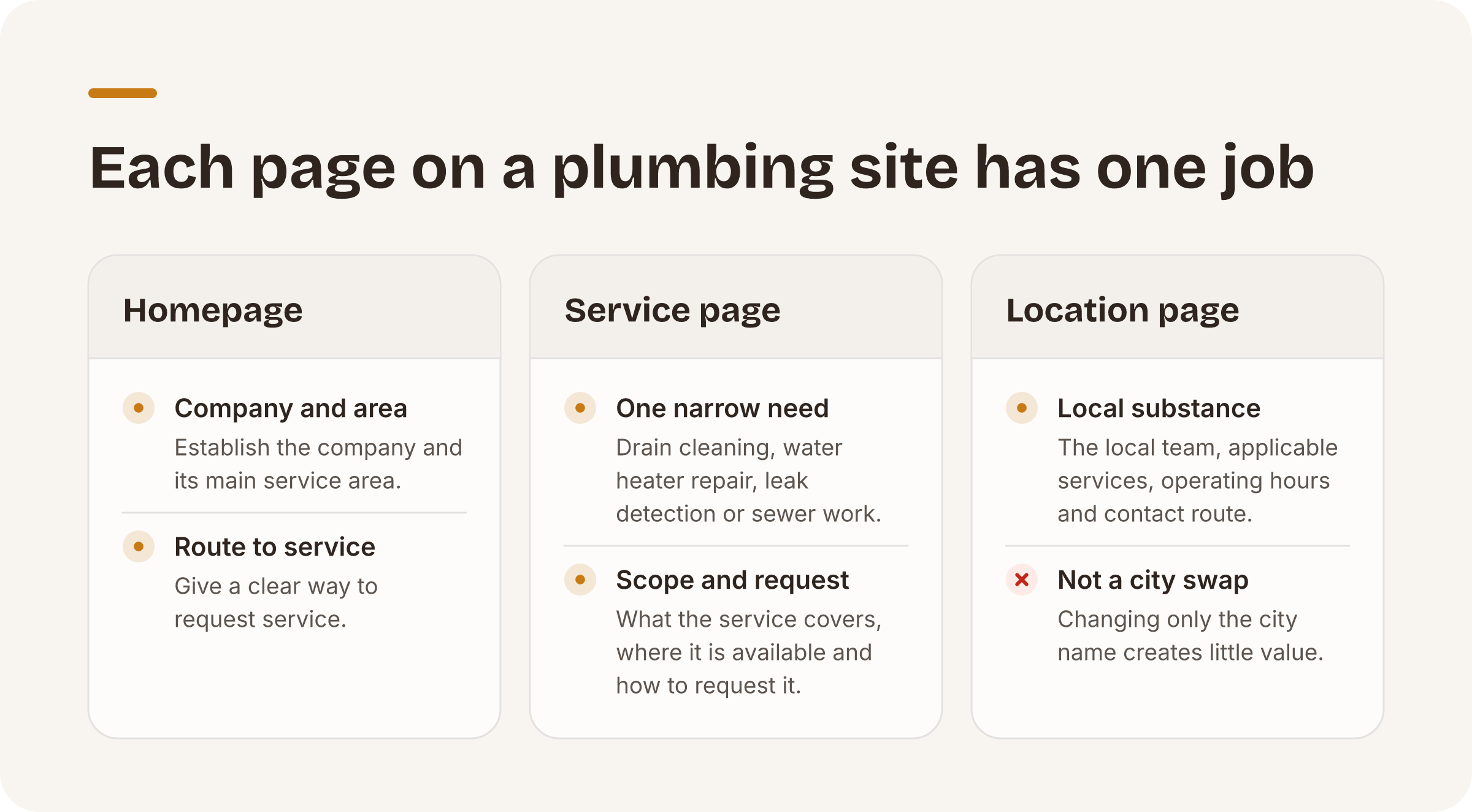
Give each page one clear purpose. State what the service covers and where it is available. Explain how someone can request it. Include licensing and availability only when those details are accurate for the business and location. Apply the same standard to pricing language.
Location pages need substantive local information. A Denver page might identify the local team, applicable services, operating hours, and contact route. Changing only the city name creates little value for the reader.
Use verifiable qualifications instead of unsupported superlatives. Useful details may include the type of work performed, the service territory, or an accurately identified license.
Using reviews in plumbing SEO
Ask real customers to describe their experience in their own words. The Federal Trade Commission says reviews should reflect honest opinions from customers or experts who actually used the product or service (accessed November 2026) (Soliciting and Paying for Online Reviews: A Guide for Marketers, accessed November 2026).
Do not write the review for the customer. Do not ask only satisfied customers while diverting complaints elsewhere. Keep the request neutral. Use the same process after each completed job. If you pay a review platform for reputation or visibility benefits, it should clearly disclose that commercial relationship (accessed November 2026).
Roadmap capability: review replies in our product are not shipped. For now, replying remains manual. A useful response acknowledges the specific service without exposing private details such as an address or invoice information. When a customer raises a complaint, recognize it publicly and then move the discussion to a private support channel.
Automated capability: review monitoring is live. Monitoring helps you find new feedback, but a person should still assess the context before responding.
How the audit scores findings
An audit should distinguish a severe data problem from a minor note. It should also show its arithmetic rather than presenting an unexplained score.
Automated capability: our audit starts each location at 100 points. The scoring formula starts at 100, then subtracts 15 points per critical finding, 7 per warning, and 2 per informational note.
A critical finding costs 15 points. A warning costs 7 points. An informational note costs 2 points. One critical finding, two warnings, and three informational notes therefore produce:
100 - (1 × 15) - (2 × 7) - (3 × 2) = 65
Each listing runs through a published checklist covering basic information, hours, ratings and reviews, photos, categories, cross-location consistency, and listing health. The listing-health checks include duplicate-pin candidates.
That score measures findings against the checklist. Google names relevance, distance, and prominence as ranking factors.
Manual capability: you still need to confirm the correct business information and approve website changes. You must also evaluate review responses. Duplicate candidates are same-brand pins within roughly 1 kilometer of each other, surfaced for a person to confirm and merge. We never merge duplicate-pin candidates automatically.
Measuring changes over time
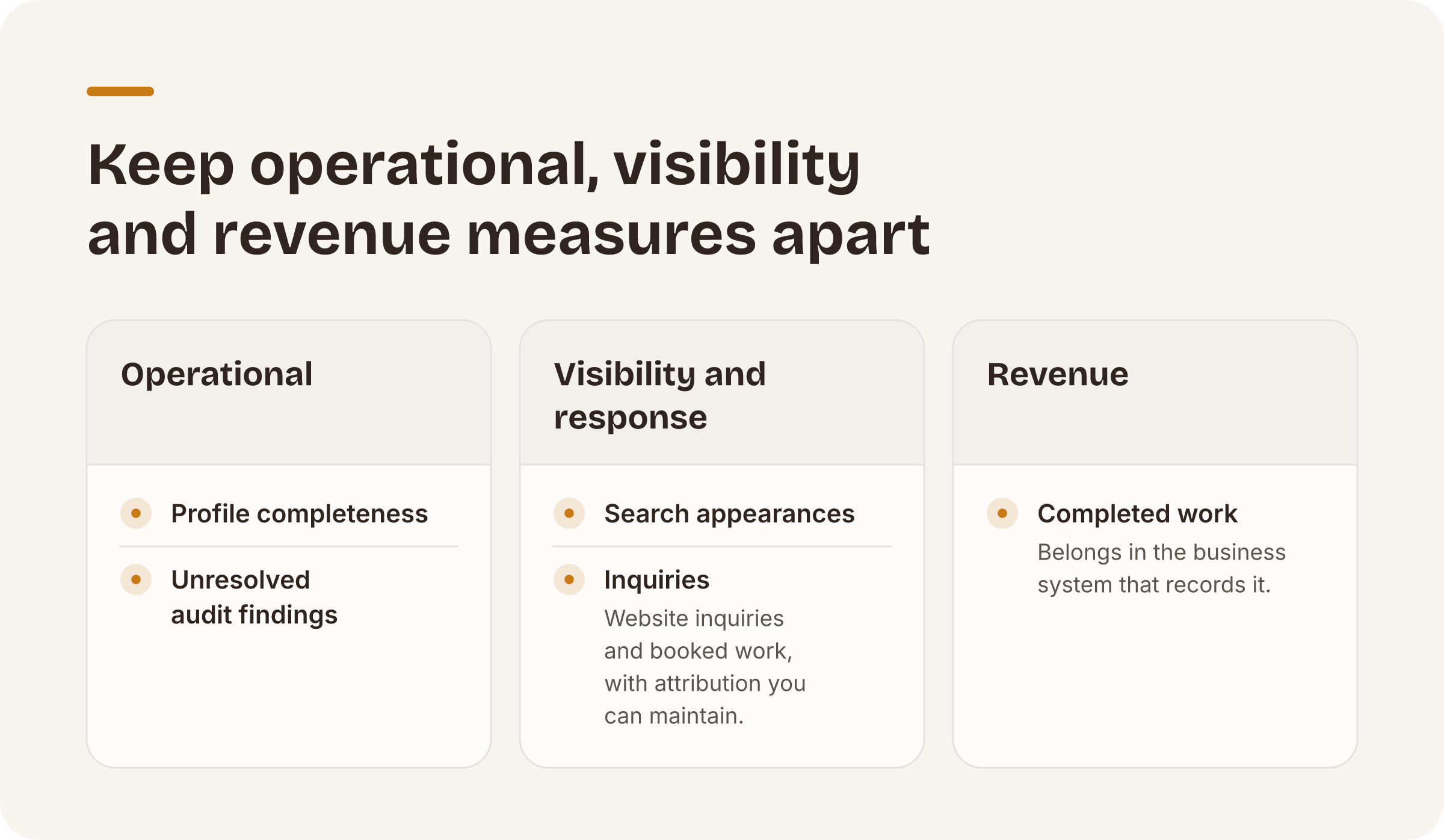
Track whether the listing remains accurate after changes to staffing, schedules, phone numbers, or services. Record website inquiries and booked work using attribution methods your business can maintain consistently.
Treat map pack positions as observations rather than permanent assets. A position viewed from one neighborhood does not establish what every searcher sees elsewhere. Whenever you record a position, include the search and location. Record the date and device context as well.
Separate operational measures from visibility measures. Profile completeness and unresolved audit findings are operational. Search appearances and inquiries measure visibility and response. Revenue belongs in the business system that records completed work.
Automated capability: you can run the free Brand Health audit without entering a card. The service is capped at three audits per email address per day.
Put this playbook on autopilot.
The free audit runs every check in this post across all your locations — no card required.