Google reputation management for multi-location brands
A practical framework for managing reviews, responses, risk, and listing quality across a multi-location portfolio.
A shared review inbox is not enough for Google reputation management across a multi-location portfolio. The work needs one policy and per-location context. It also needs a clear boundary between automated detection and manual judgment.
What should online reputation management include?
You need to monitor new feedback and route it to the right operator. You also need to maintain accurate listings and document your team’s response.
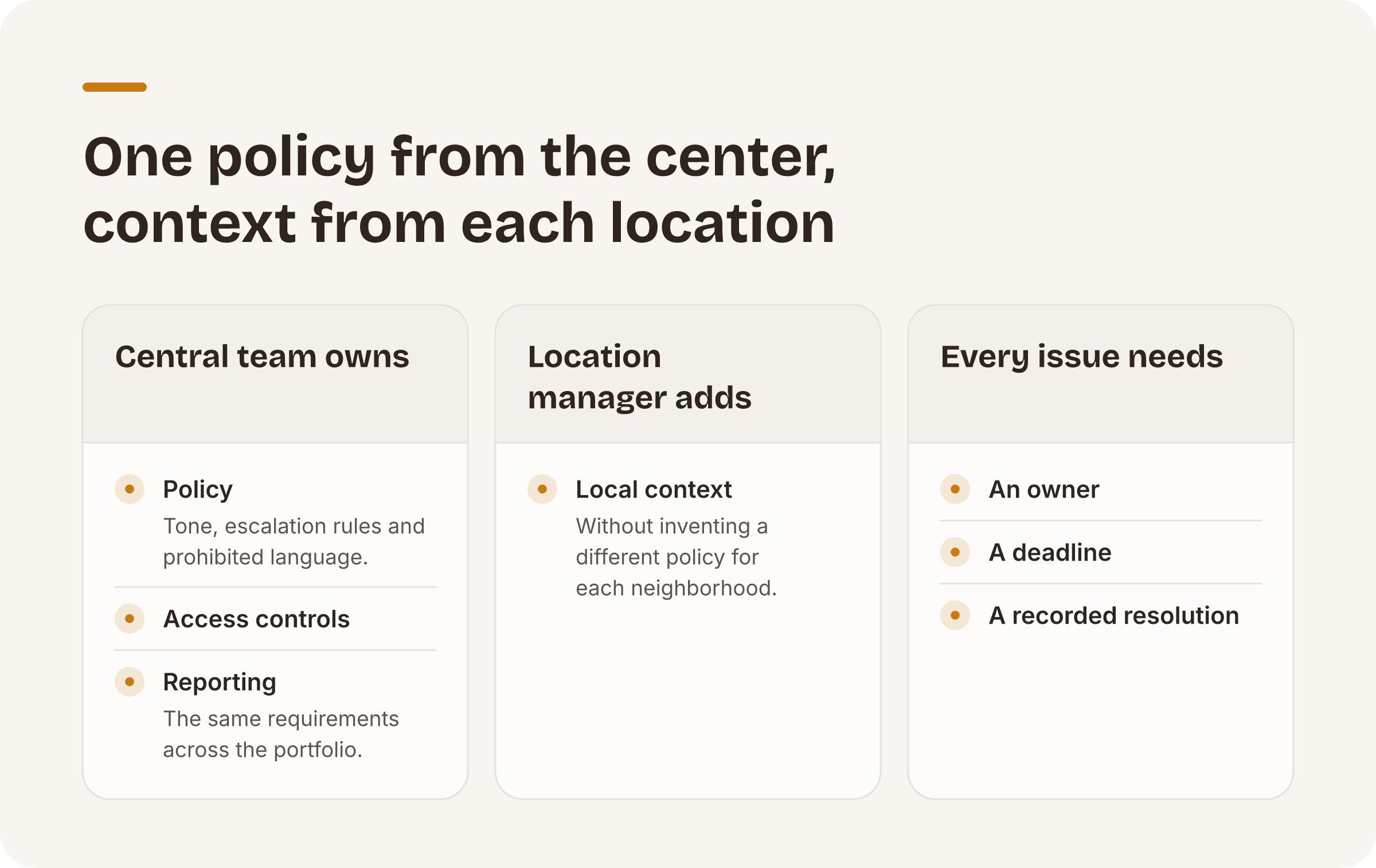
The central team should own the policy, including tone and escalation rules. It should also define prohibited language and access controls. Reporting requirements should be consistent across the portfolio. A location manager can then add context without inventing a different policy for each neighborhood.
Listing quality belongs in the same operating model. A review may concern incorrect hours or an unavailable service. It may also identify a confusing address.
The response handles the public comment. The listing correction addresses the underlying information.
This distinction matters in reputation management for businesses with many locations. A polished reply does not correct the source of a repeated complaint. The issue needs an owner and deadline, followed by a recorded resolution.
What should reputation management software automate?
Automated capability. A Google reviews management tool should collect new reviews and place them in a common queue. PlaceOptimizer review monitoring is live. Google’s reviews endpoint works only for a verified location (accessed November 2026) (Method: accounts.locations.reviews.list, accessed November 2026). The response can include review details, average rating, total review count, and pagination data. Filtering supports page size, page token, and sorting order (accessed November 2026).
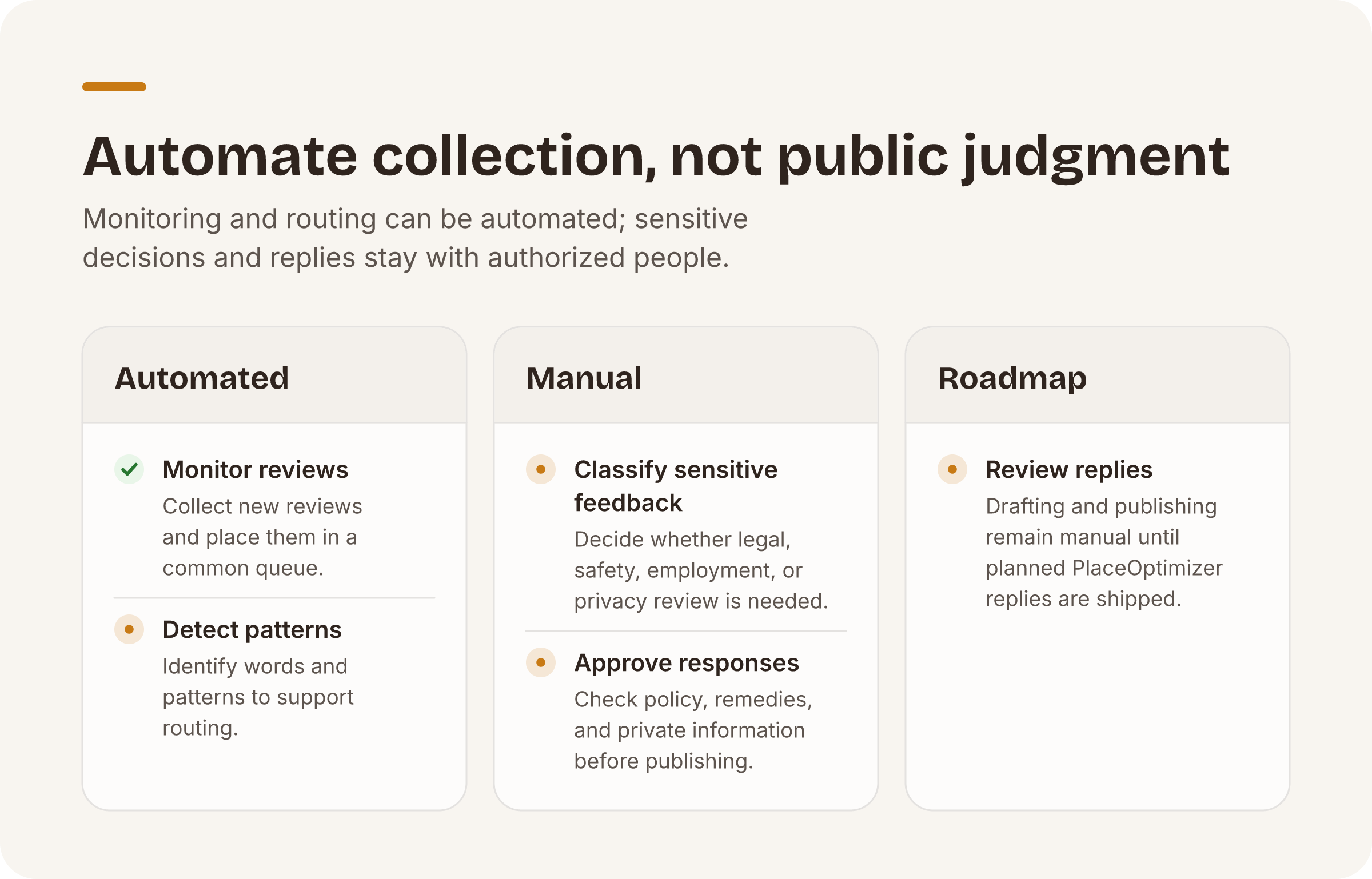
Manual capability. A person should classify sensitive feedback and decide whether the response needs legal, safety, employment, or privacy review. Automation can detect words and patterns. It cannot establish the full context behind an allegation.
Manual capability. Response approval should remain with an authorized person. A draft may name the wrong policy or promise a remedy that the location cannot provide. It could also reveal information that should remain private.
Roadmap capability. PlaceOptimizer review replies are planned rather than shipped. Review monitoring is available. You should treat reply drafting and publishing as a manual workflow until that status changes.
Automation should reduce collection and routing work. It should not turn public responses into an unattended publishing queue.
How should Google reviews management work across locations?
A practical workflow separates automated detection from manual judgment. Action and measurement follow. You can run it as a short sequence:
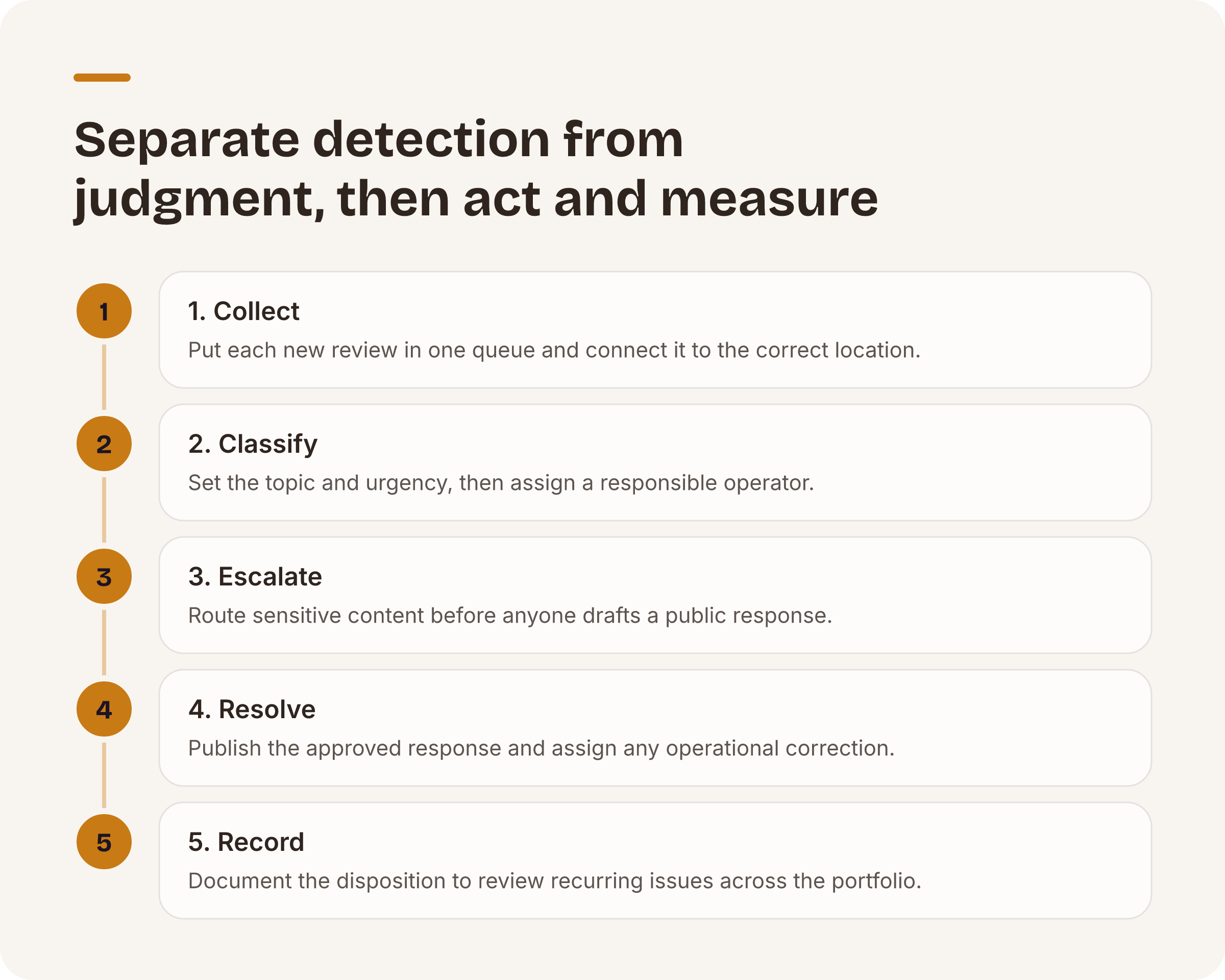
- Collect each new review in one queue and connect it to the correct location.
- Classify the review by topic and urgency, then assign a responsible operator.
- Escalate sensitive content before anyone drafts a public response.
- Publish the approved response and assign any operational correction.
- Record the disposition so your team can review recurring issues across the portfolio.
Use a controlled set of classification topics. These might cover hours or service availability. Other useful topics include staff conduct, billing, accessibility, cleanliness, or address accuracy. Free-form labels make cross-location analysis harder because similar issues acquire different names.
Urgency should reflect the underlying risk rather than the star rating alone. Review detailed safety allegations promptly. A favorable review that exposes personal information may also require attention.
The assigned operator should own the operational issue, not merely the response.
If several comments concern posted hours, the listing owner should verify them. If feedback concerns an internal process, the relevant operating team should review that process.
What legal boundaries apply to review programs?
Review acquisition needs a documented policy. The US Federal Trade Commission’s rule can impose liability for writing, creating, or selling fake or false consumer reviews (The Consumer Reviews and Testimonials Rule: Questions and Answers, accessed November 2026). It also covers incentives conditioned on a particular sentiment (accessed November 2026).
The rule addresses review suppression and the misuse of fake or false social-media influence indicators (accessed November 2026). A workflow that hides criticism by default creates a different risk from one that escalates abuse or sensitive content for legitimate review.
Your policy should separate asking for feedback from dictating its content. Staff should not write reviews for consumers or require positive wording. They also should not make the resolution of a complaint depend on removing criticism.
Public replies need privacy limits. Your team can acknowledge a concern and offer a private channel without confirming personal details.
The public response is not the place to reproduce an internal record.
Does reputation management control map pack rankings?
We do not control or guarantee a position in the map pack. Google identifies relevance, distance, and prominence as local-ranking factors. It also says complete, accurate information helps match a business to relevant searches (accessed November 2026) (How to manage Google Business Profiles for retail chains in India).
Reputation work can improve inputs you control. You can keep listing information accurate and monitor feedback. You can also correct operational problems revealed by reviews. You cannot remove distance from the ranking system or promise a particular position.
Read any vendor score according to its published checklist. Each location starts at 100 and loses points for checklist findings. It is not a forecast of map pack position.
How should you measure listing quality?
A useful audit separates severe errors from smaller improvements. The arithmetic should remain visible so you can reproduce the result.
Automated capability. The Brand Health audit starts each location at 100 points. A critical finding costs 15 points: 100 − 15 = 85. A warning costs 7 points: 100 − 7 = 93. An informational note costs 2 points: 100 − 2 = 98.
Findings are cumulative. One critical issue, one warning, and one informational note produce a score of 100 − 15 − 7 − 2 = 76. Location scores reflect findings on the published audit checklist.
Keep operational reporting separate from the audit score. Track whether a review has been classified and assigned. Then record whether it was escalated, answered, and closed. These states show where work is waiting without treating every review as equally important.
Portfolio reporting should preserve location detail. An overall average can conceal one listing with an unresolved issue.
You need both the multi-location portfolio view and the underlying per-location record.
Where should you start?
Begin with the listing data that shapes the rest of the workflow.
Automated capability. You can run a free Brand Health audit to identify the first issues to assign. It requires no card and is capped at three audits per email per day.
Put this playbook on autopilot.
The free audit runs every check in this post across all your locations — no card required.